
Modern workplaces are increasingly global, multilingual, and culturally diverse. While most companies focus on structural silos between departments, many collaboration challenges come from invisible cultural silos inside teams. Understanding these dynamics is essential for HR leaders, managers, and organizations working across languages and cultures.
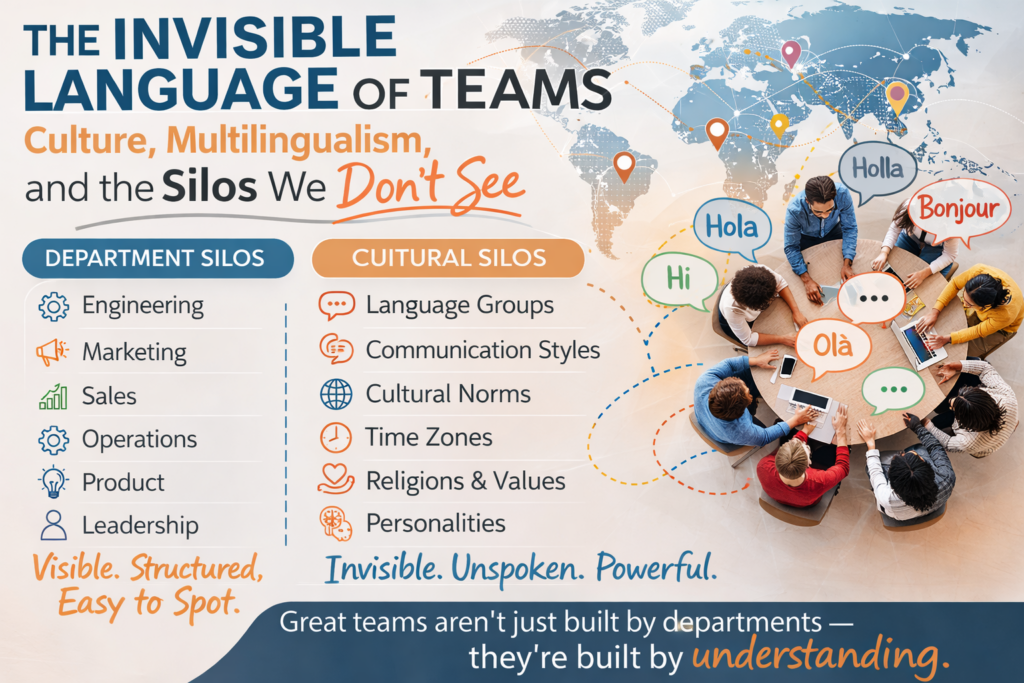
In most organizations, when we talk about silos, we mean departments.
Engineering and marketing don’t communicate.
Sales and operations operate independently.
Product teams and leadership interpret priorities differently.
But after working for years in Human Resources and later spending time teaching languages and studying intercultural communication, I’ve come to realize that some of the strongest silos inside organizations are not departmental at all.
They are linguistic and cultural.
And many leaders don’t see them.
The comfort of speaking with “our people”
Human beings naturally gravitate toward familiarity.
In international companies, especially those operating remotely, people often cluster around others who share:
- their language
- their cultural references
- their communication style
- their sense of humor
- even their silence
This isn’t exclusion. It’s comfort.
A Brazilian employee might naturally connect with another Brazilian colleague.
Two engineers from Eastern Europe may collaborate easily because their communication style is similar.
Employees who share a religious or cultural background may gravitate toward each other socially.
None of this is wrong.
But when organizations grow and teams become global, these informal cultural clusters can quietly turn into invisible silos.
And unlike departmental silos, they are rarely discussed.
Language is not just vocabulary
In corporate settings we often treat language as a technical skill:
“Do you speak English?”
“Is the team fluent in Spanish?”
“Can the client communicate in French?”
But language is far more than vocabulary and grammar.
Language carries:
- cultural norms
- hierarchy signals
- humor
- indirect meaning
- emotional nuance
- non-verbal cues
A phrase that sounds direct and efficient in one culture may sound abrupt or even rude in another.
Silence may signal disagreement in one context and respect in another.
Even body language (something I’ve studied extensively) varies widely across cultures.
Eye contact, gestures, physical space, and tone all carry meaning that people interpret through cultural lenses.
This is where language and Human Resources intersect in powerful ways.
The remote workplace magnifies these differences
Remote work has made global collaboration easier than ever.
Teams today often span:
- multiple countries
- multiple time zones
- multiple native languages
But remote environments remove many of the subtle signals that help people understand one another.
When communication happens mostly through:
- Slack messages
- video calls
- email threads
small linguistic differences can quickly become misunderstandings.
A short message meant to be efficient may be interpreted as cold.
A polite indirect suggestion may go unnoticed by a more direct communicator.
Without realizing it, teams may begin to collaborate mostly with people who communicate the way they do.
And slowly, the cultural silos deepen.
What good HR leaders begin to notice
One of the most valuable skills in Human Resources is learning to see the invisible dynamics inside organizations.
Not just job titles and org charts, but human behavior.
Who speaks during meetings.
Who remains quiet.
Who collaborates easily.
Who struggles to be heard.
Language plays a major role in all of this.
Employees who are working in their second or third language may be highly competent but hesitant to interrupt a fast-moving discussion.
Others may dominate conversation simply because the communication style of the organization matches their own.
These dynamics rarely appear in performance reviews, yet they shape the daily experience of employees.
Multilingualism as an organizational advantage
Companies often treat multilingualism as a practical asset — useful for international clients or global markets.
But multilingual environments can offer something deeper: cognitive diversity.
People who operate in more than one language often develop:
- higher tolerance for ambiguity
- stronger listening skills
- cultural adaptability
- awareness of context and tone
When organizations create environments where different linguistic and cultural perspectives are respected, teams often become more thoughtful, creative, and collaborative.
But that requires intention.
Building bridges across invisible divides
Human Resources professionals are uniquely positioned to help organizations recognize and navigate these dynamics.
This doesn’t require forcing people to abandon their cultural identities.
It requires creating structures that encourage cross-cultural curiosity and communication.
For example:
- encouraging meeting formats where quieter voices have space to contribute
- recognizing that communication styles vary across cultures
- providing leadership training in intercultural communication
- creating onboarding processes that acknowledge global teams
Even simple awareness can transform how teams interpret each other.
When people realize that a communication difference is cultural rather than personal, the conversation changes.
The real language of organizations
Organizations often believe they operate in a single language — English, Spanish, or another dominant language.
But in reality, companies operate in many languages simultaneously:
- the language of culture
- the language of hierarchy
- the language of personality
- the language of experience
Understanding these invisible layers can transform how teams collaborate.
And perhaps most importantly, it reminds us that communication is not just about words.
It is about understanding people.