What happens when a writer refuses to choose one language over another?
For many multilingual authors, writing is not a matter of translation; it is a matter of coexistence. The mother tongue carries memory, rhythm, and emotional instinct. A second language carries discovery, distance, and often reinvention. When both are allowed to inhabit the same page, something structurally and cognitively significant occurs.
Writing in multiple languages is not simply aesthetic experimentation. Research in bilingual cognition suggests that multilingual individuals activate distinct conceptual frameworks depending on the language they are using. Vocabulary does not merely label experience; it shapes it. As I’ve written before in Why Language Learning Matters Now More Than Ever, language does more than communicate — it reshapes cognition and expands cultural perspective.
Certain emotions, metaphors, and cultural references feel more natural in one language than in another. To write bilingually is to acknowledge that no single linguistic system contains the full range of one’s identity.
In the arts, this blending challenges traditional expectations. Readers are often accustomed to translation as clarification. But bilingual writing without translation invites a different experience: one of active participation. The reader navigates context, inference, sound, and structure. Meaning is not always handed over; it is discovered.
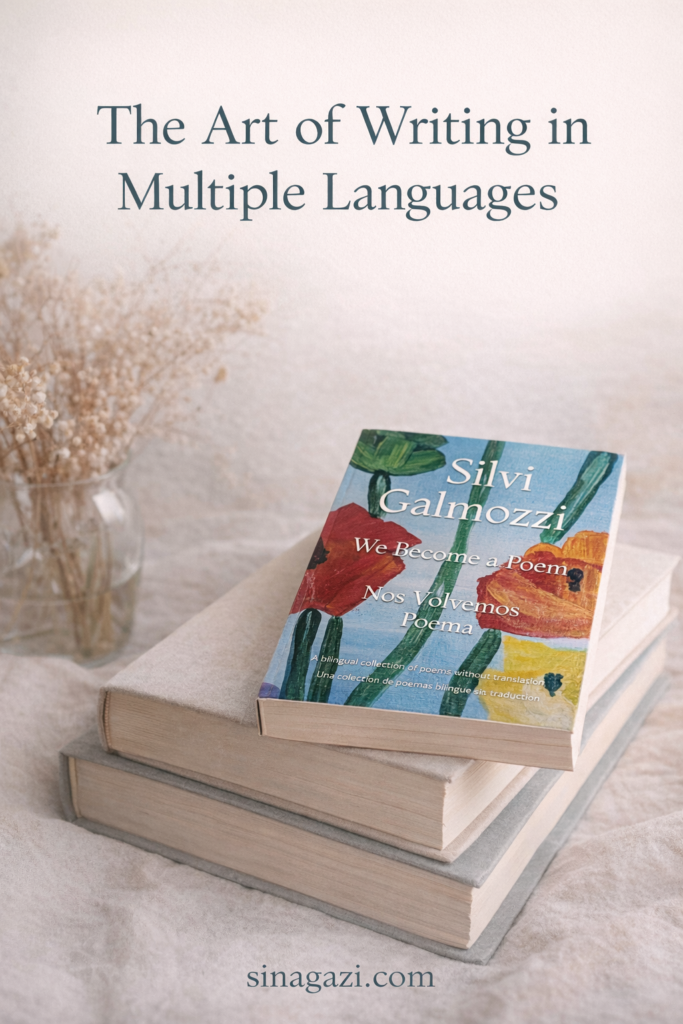
In my own bilingual poetry collection, We Become a Poem / Nos Volvemos Poema, the texts move between English and Spanish without mirroring translation. The languages coexist on the page, not as duplicates, but as companions. The goal is not to teach the reader both languages. The goal is to reflect how many of us actually think — layered, intersecting, shifting.
Writing across languages is not fragmentation. It is integration.
It allows art to mirror the lived experience of multilingual communities, heritage speakers, immigrants, and language learners alike. It acknowledges that identity is rarely monolingual.
On International Mother Language Day and beyond, it is worth considering not only how we preserve languages but how we allow them to meet each other in creative spaces. This aligns with the idea I explored in Read, Write, and Enjoy the Language Learning Journey, where reading and writing are not separate skills but integrated forms of thinking in the language.
Sometimes the most honest form of expression is not choosing one language, but allowing both to speak.
UNESCO reports that nearly half of the world’s languages are at risk of disappearing.