
Recently, I found myself at the beginning of two entirely new learning curves.
One was unexpected. A local Kung Fu studio began offering Qigong classes, and without much prior knowledge (or even a clear understanding of what I was signing up for) I decided to go. There was something in the idea of it that felt worth exploring, even without a defined outcome.
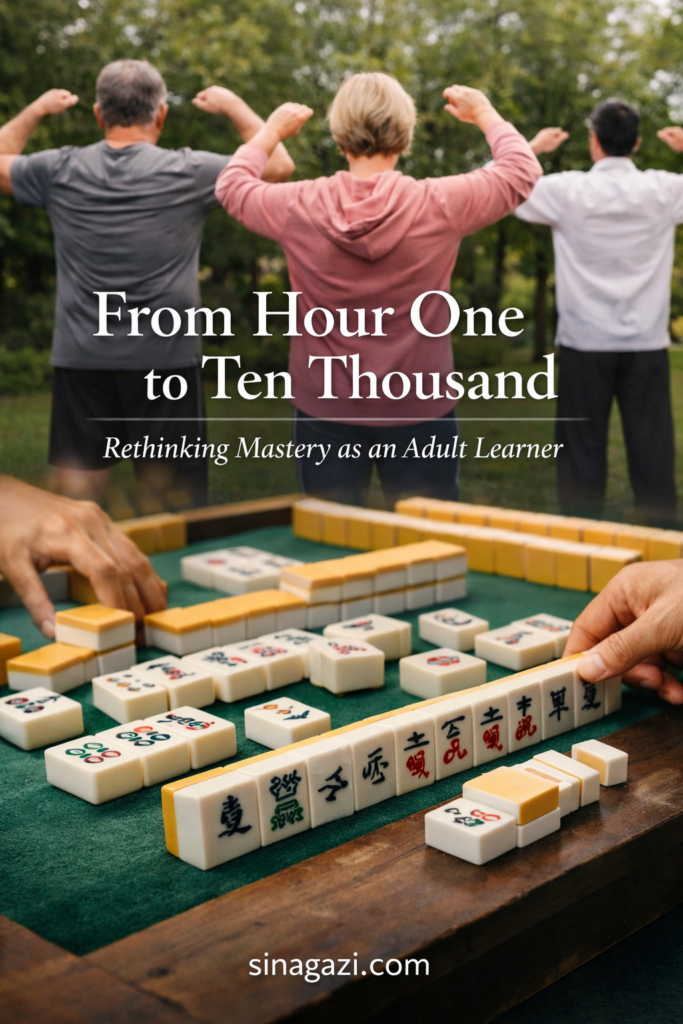
The other had been waiting for years. Mahjong. A game I had always been curious about, but never quite pursued. That changed when a neighbor and friend gathered a small group of us and offered to teach us how to play. This time, the curiosity was not spontaneous, it was long-standing, almost patient.
As a language instructor, my mind did what it always does. It connected.
If these practices—Qigong and Mahjong—became more than passing interests, would I eventually feel the need to learn Mandarin? Or Cantonese? Would the language become part of the experience, not as an obligation, but as a natural extension of understanding?
The thought was almost immediate. And with it came a deeper question:
How long does it take, as adults, to know whether something we are learning will truly become part of us? Not to master it, not even to excel, but simply to know if we can grow into it, enjoy it, and stay with it.
This question, perhaps more than the idea of mastery itself, is what shapes the adult learning experience.
The Structure We Inherit: The Myth of 10,000 Hours
We have heard of the “10,000-hour rule,” popularized in discussions of expertise and mastery. While often oversimplified, the underlying idea points to something real: mastery takes sustained, long-term engagement. But what is less discussed, and perhaps more relevant for adult learners, is how those hours are experienced in stages. What happens in the first 100 hours? What distinguishes the first 1,000 from the next 9,000? And perhaps most importantly: how do we know whether to continue, adapt, or stop?
The First 100 Hours: Encounter, Friction, and Identity Shock
The first 100 hours are not about mastery. They are about survival.
In Qigong, it may be the awareness of the body moving in ways that do not yet feel intuitive. In Mahjong, it may be the rules, the tiles, the constant need to ask, “Wait—what happens next?”
This is the stage where everything feels slower than expected. Progress is uneven, feedback is constant, and competence is fragile. It is also the stage where many adult learners quietly disengage, not because they lack ability, but because they misinterpret the experience.
In these early hours, learning is less about accumulating knowledge and more about building a relationship with the subject. The brain is forming initial pathways, but just as importantly, the learner is negotiating identity. “Am I someone who can do this?” becomes as central a question as “How does this work?”
The most effective use of the first 100 hours is not exhaustive study, but structured exposure. Short, frequent sessions outperform long, inconsistent ones. Immediate feedback matters more than theoretical understanding. Repetition is not a sign of failure but a necessary condition for familiarity.
Perhaps the most important shift at this stage is reframing frustration. What feels like inefficiency is often the visible surface of cognitive restructuring. The discomfort is not evidence of incapacity…it is evidence of engagement.
From 100 to 1,000 Hours: Pattern Recognition and Emerging Competence
Somewhere between hour 100 and hour 1,000, something subtle begins to change. The learner no longer feels entirely foreign within the domain. Patterns begin to emerge. What once required conscious effort starts to become partially automatic. In Mahjong, familiar combinations start to emerge. In Qigong, movements begin to flow with less conscious effort. There is still uncertainty, but it is now accompanied by moments of recognition.
The learner is no longer asking only what something is, but why it behaves the way it does. Mistakes become more informative, less destabilizing. There is enough familiarity to begin making predictions, and enough skill to notice nuance.
However, this stage carries its own risks. Progress is still occurring, but it is less dramatic than in the beginning. The initial excitement has faded, and mastery still feels distant. Many learners plateau here, not because they have reached their limits, but because they continue practicing in the same way that worked for them as beginners.
The transition from beginner to intermediate requires a shift from passive exposure to deliberate practice. It is no longer enough to “do the thing.” One must begin to identify weaknesses, isolate them, and work on them intentionally.
At this stage, consistency becomes more important than intensity. The learner who engages regularly, even in small increments, will outpace the one who relies on occasional bursts of effort.
From 1,000 to 10,000 Hours: Refinement, Depth, and Personal Style
If the first 1,000 hours are about learning the rules, the next 9,000 are about learning when and how to bend them.
By this stage, the learner has achieved functional competence. They can perform within the domain with a degree of reliability. The focus now shifts from acquiring skill to refining it. In practices like Qigong, this may manifest as a deeper internal awareness rather than visible complexity. In games like Mahjong, it may appear as strategic foresight and adaptability.
This is where depth emerges.
The learner begins to develop a personal style, an intuitive sense of timing, and an ability to adapt to complexity. They are no longer just responding to the task—they are shaping it. Feedback becomes more nuanced, often coming from peers or mentors rather than structured systems.
Importantly, progress at this stage is not linear. Gains are incremental, sometimes invisible. Improvement may take the form of increased efficiency, subtle accuracy, or deeper understanding rather than dramatic breakthroughs.
Sustaining engagement over this span of time requires more than discipline. It requires meaning. Learners who connect their practice to a broader purpose—creative expression, professional growth, personal fulfillment—are more likely to persist through the slower phases of development.
The Question of Quitting: When Is It Time to Let Go?
One of the most complex aspects of adult learning is not how to continue, but how to decide whether continuing is worthwhile.
There is a persistent cultural narrative that equates persistence with virtue and quitting with failure. In reality, the decision to stop can be as thoughtful and intentional as the decision to begin.
The question is not simply whether progress is being made, but how that progress is experienced.
If, after a meaningful investment of time, often beyond the initial 100 hours, the learner observes no improvement in understanding or performance despite consistent and varied effort, it may be necessary to reassess methods. Sometimes the issue is not the subject itself, but the approach.
However, there are deeper signals to consider. Does the activity generate curiosity, even in small amounts? Is there a sense of engagement, however intermittent? Or does the experience remain persistently draining, disconnected, and resistant to change?
Quitting becomes a valid option not when something is difficult, but when it is misaligned.
To stop learning something is not to fail; it is to redirect finite time and energy toward something more resonant. Adults, perhaps more than anyone, must learn to make these decisions with clarity rather than guilt.
Rethinking Mastery
The idea of 10,000 hours can feel overwhelming, even discouraging. But when broken into stages, it becomes less of a distant summit and more of a landscape with identifiable terrain.
The first 100 hours are about entry.
The first 1,000 hours are about stability.
The next 9,000 are about depth.
Not everyone needs (or wants) to reach the final stage. And not every pursuit requires mastery to be meaningful.
For the adult learner, the goal is not always expertise. Sometimes it is participation. Sometimes it is curiosity. Sometimes it is simply the act of beginning again. And sometimes, as in the case of a spontaneous Qigong class or a long-awaited Mahjong game, the act of beginning is already a meaningful answer.
And that, in itself, is a form of mastery.